
Stop Mixing Brand, Non-Brand, and Conquest Traffic
Google will happily serve your ad for “running shoes” when someone types a competitor’s name, and your ad for “chiropractor near me” on the name of every practice in a five-state area. That is great for Google’s revenue. It is often terrible for yours.
If brand, non-brand, and conquest queries live in the same campaign, your reporting will lie to you. Brand traffic makes the blended ROAS look like a hero. Non-brand, where new customers actually come from, gets starved or mis-measured. Search is still the foundation, and YouTube and Meta can add reach around it. None of that works if you cannot tell which search traffic is doing the work.
The Three Buckets
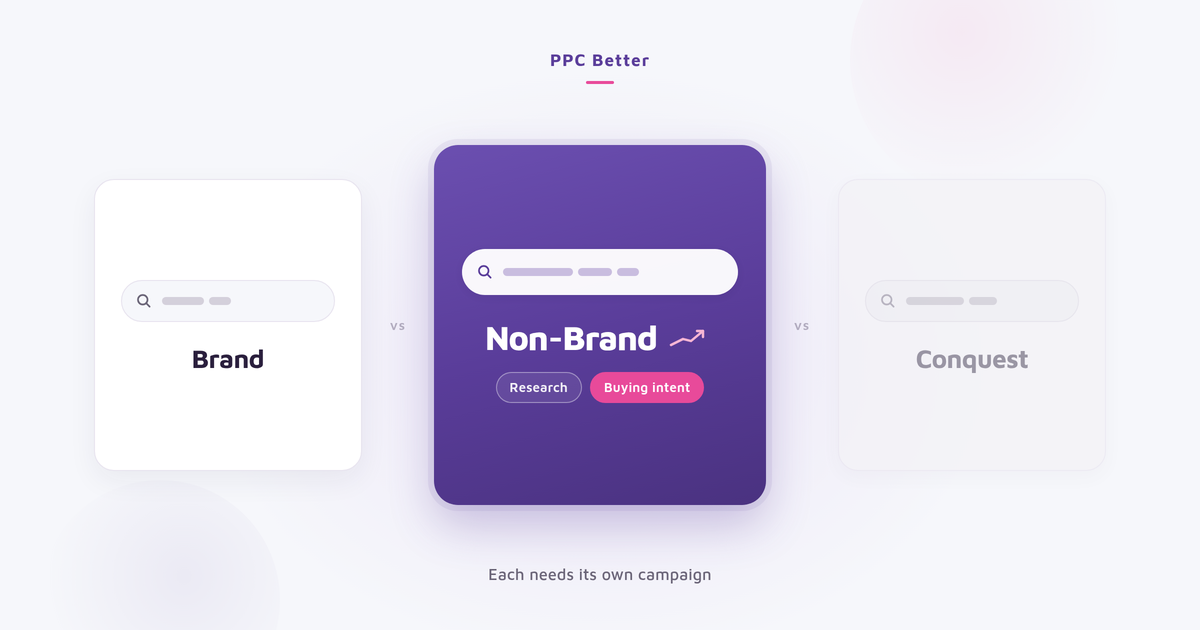
My brand is PPC Better. So “PPC Better,” “ppc better reviews,” and queries like that are brand keywords. “PPC management agency” or “AI automation agency Nashville” are non-brand. A competitor’s name is also technically non-brand, but I put those in a third bucket: conquest.
The intent is not the same. Someone searching “best kitchen remodeling contractors in Toledo” is shopping the category. Someone searching “Bill’s Modern Kitchens Toledo” already has a company in mind. Treat those as the same click and you will bid wrong, budget wrong, and congratulate yourself for the wrong reason.
Why They Need Their Own Campaigns
Budgets in Google Ads are set at the campaign level. If you want to buy almost every brand impression, fund profitable non-brand, and keep conquest from eating that money, you need separate campaigns. The structure I use is straightforward: brand search that blocks non-brand and competitor queries, non-brand search that blocks brand and conquest, Performance Max that blocks brand, and conquest, if you run it, in its own campaign.
This is harder to get dialed in than it sounds, because close variants keep trying to bleed categories into each other. You still do it. Do not treat this as a fixed pile of money that can go to brand or to non-brand. Done correctly, brand campaigns often cost very little and return substantially better than non-brand. Non-brand should get budget when it is profitable, and more budget as long as it stays profitable. Defending your name should not be the reason you underfund the campaign that finds new customers.
Brand Is Defense, Not a ROAS Pump
Unless you have no competitors, you probably need to buy your brand. If you don’t, those customers can slip away to competitors offering discounts to people searching your name. I do not use brand campaigns to pump account ROAS. I use them so an affiliate or a competitor cannot sit in the #1 spot and siphon people who already wanted you.
If you buy brand in a standalone campaign that only targets brand and blocks non-brand and competitor queries, you can often buy those clicks at an 80% or better discount. I aim for tightly controlled brand campaigns with 95% or better impression share on core brand terms, then spend the rest of the budget on the best-converting non-brand traffic I can buy. Bid for presence, not for a vanity CPA. Manual CPC or target impression share both work. Skip regular broad match on brand, or Google will match you into product queries that do not include your name.
Important Caveat: Google will still sneak non-brand queries into a brand campaign. You can reduce it with negatives and a “whack-a-mole” script, but you will not eliminate it completely. If you have a trademark, file it with Google so competitors cannot hard-code your name into their ad copy.
Non-Brand Is the Growth Engine
Brand stats tell you how much people already like you, and how many customers other channels convinced to search your name. Non-brand is how you acquire net new customers. That is why I care about non-brand ROI as its own number, and why I will not let brand terms live in a non-brand campaign. Non-brand is not one pile of traffic. I split it by intent.
Research Intent
Research queries are the questions people type before they have decided what the problem is. Think of any purchase: a car, a home, dandruff shampoo. The first searches are educational. “Dentists.” “Roofing.” “What is X used for.” Conversion rates are lower because the person is not ready to buy. Driving them to “request info from sales” or a checkout page is often the wrong ask. We usually get better results with a product-education offer: collect an email, add them to a remarketing audience, and keep the brand in front of them as they move closer to a purchase. High-quality YouTube and Meta traffic can complement search here, if you are measuring leads and revenue, not views.
Purchase Intent
Purchase-intent queries often carry cost or time modifiers. “Emergency dentist” is a different keyword from “dentists.” “Roof replacement prices” is different from “roofing.” “Restaurants near me open late” is different from “restaurants” plus a city name. In B2B, that intent can show up as part numbers, or as niche software names.
Users who type these keywords can be 2–8x more likely to convert, if you are measuring real outcomes: transactions, phone calls, form fills, and the email signups you actually intend to capture. This is the growth engine. Buy more high purchase-intent traffic, and less people doing research. I like to buy the funnel from the bottom up: fund the profitable purchase-intent terms first, and only climb into research terms if the budget still works.
Conquest Plays by Different Rules
Conquest is bidding on a competitor’s name. It is not the same as clean non-brand. I disagree with the idea that conquest is more valuable because “someone is already in market.” If you are counting clicks, maybe. If you want customers, local brand conquest often looks like this: you answer the phone, “Thanks for calling Jim’s Plumbing.” They say, “Is this Mike’s Plumbing?” You say no, you can still help. They hang up and call Mike. Eight out of ten, or better, of those calls can go that way.
In most accounts, conquest converts one-half to one-third as well as clean non-brand. Clean non-brand has a lower cost per customer and higher ROAS than conquest in 95% or more of the cases I see. If you are limited by budget, which most advertisers are, you buy the better return first. That means blocking as much conquest as possible out of the standard non-brand campaign.
It is possible to make conquest profitable, but it usually takes a comparison page with the competitor’s name on it. I usually use a chart: our brand gets the green checkmarks, the competitor gets a mix of checks and red Xs. Navigational queries like “phone number,” “directions,” or “address” are often the worst of this traffic. Negative those out.
Trademark caveat: I am not a lawyer, and you should get your own legal advice. If a name is trademarked and protected in Google Ads, your ad will often get disapproved if you hard-code that name into the copy. You can usually still bid on the keyword with a generic ad. Dynamic keyword insertion can sometimes drop a protected name into an ad. Do not come looking for sympathy if that produces a screenshot and a lawsuit. Run conquest in its own campaign, with its own ads, landing pages, and budget, or do not run it.
The Blunders That Inflate the Scoreboard
PMax and broad match eating brand. It is common to find that most of a Performance Max campaign’s top search terms are brand queries, with no brand exclusions set. There is a dispute about whether leaving brand in “helps” PMax. I have not seen much evidence of that. If you do not realize those conversions were people searching your name, you will get a very skewed view of performance. At PPC Better we block brand from PMax and run a standalone brand search campaign to keep pesky competitors at bay.
Blended reporting. Last-click attribution will often give the sale to “your brand” after the customer first found you on a non-brand query. The account ROAS looks elite. The non-brand campaign looks weak. Then someone pauses the “expensive” non-brand keywords and growth stalls. Anything north of 20x ROAS, in my experience, is a signal you may be buying mostly brand traffic, selling to existing customers, or measuring wrong. Do not use brand to decorate the average.
Mixing research, purchase, and conquest under one budget. The cheaper research questions can soak up spend that should have gone to “emergency dentist.” In a multi-location pest control account, the previous agency’s broad match was sending competitor-name clicks into the main campaign. Those converted worse than generic pest control queries. We blocked that traffic from the primary non-brand campaign, tested conquest separately, and categorized spend into Brand, Generic, and Conquest. That work sat alongside better bidding and conversion tracking. Year over year, leads were up 151% and cost per lead was down 60%. The lesson was not “conquest more.” It was “stop blending the categories and buy the traffic that actually pays.”
Book a Discovery Call
If you want a clean read on brand defense, non-brand growth, and whether conquest is worth a dollar, book a discovery call. Just click through to our contact page. We can help you run a profitable Google Ads, YouTube, and Meta Ads campaign.
Hope that helps!